Why Practical AI Could Be Africa’s Biggest Opportunity
A new World Bank report highlights the growing opportunity for AI in Africa. Discover where the jobs could emerge, why practical AI solutions matter, and how young Africans can turn their local knowledge into an advantage in the AI economy.
If you are young and in Africa, it is easy to feel that AI is happening without you. The big tools, the big companies, the big money all seem to sit somewhere else. At AmaliTech, we work with young African talent every day, and we see a different picture. A new World Bank report now puts data behind it. The opportunity in AI is real, and the work of building it has barely begun.
The world's fastest-growing workforce
Over the next few years, Africa will add more young workers than anywhere else on earth, around 620 million. They will all need jobs, and today's growth isn't creating enough.
This is where AI comes in. The report says it could add up to a trillion dollars to Africa's economy by 2035 and create 35 to 40 million new digital jobs. For Ghana specifically, it found that widely shared AI gains could lift three times as many people out of poverty as gains that stay with the few already ahead.
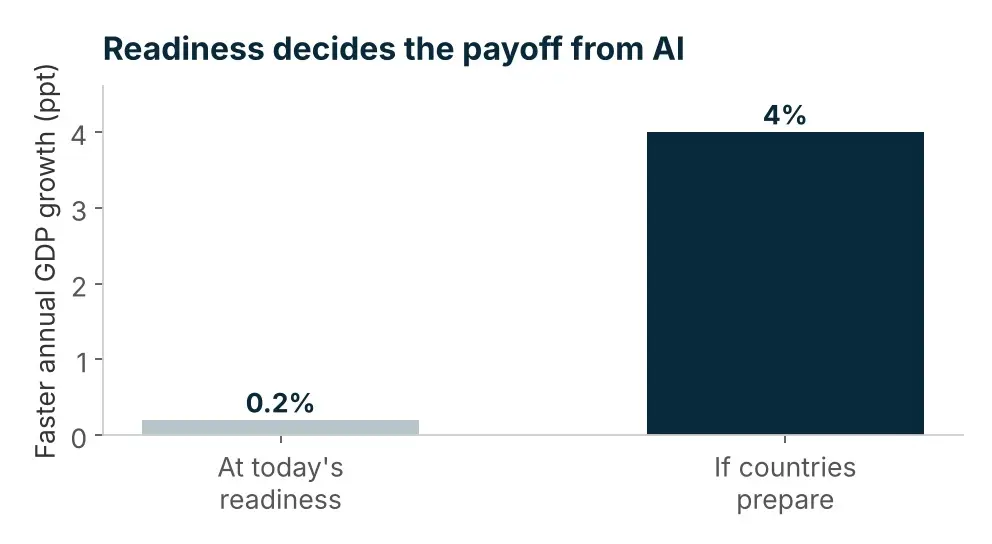
None of that is guaranteed. Most African countries aren't ready for AI yet, and at today's pace, the gains over the next ten years would be tiny. Prepare for it properly, and they could be twenty times bigger.
Those jobs will not appear on their own. People have to build them, and much of that work will likely fall to those who prepared early. So, the question for anyone starting is: where exactly is the opening, and is there still room to get in?
The work is only just beginning
Right now, few people in Africa use AI. At the start of 2026, fewer than one in ten working-age people in most African countries had used tools like ChatGPT. South Africa was ahead, Rwanda was near the bottom, and most of the money and the companies sat in just three places: Kenya, Nigeria and South Africa.
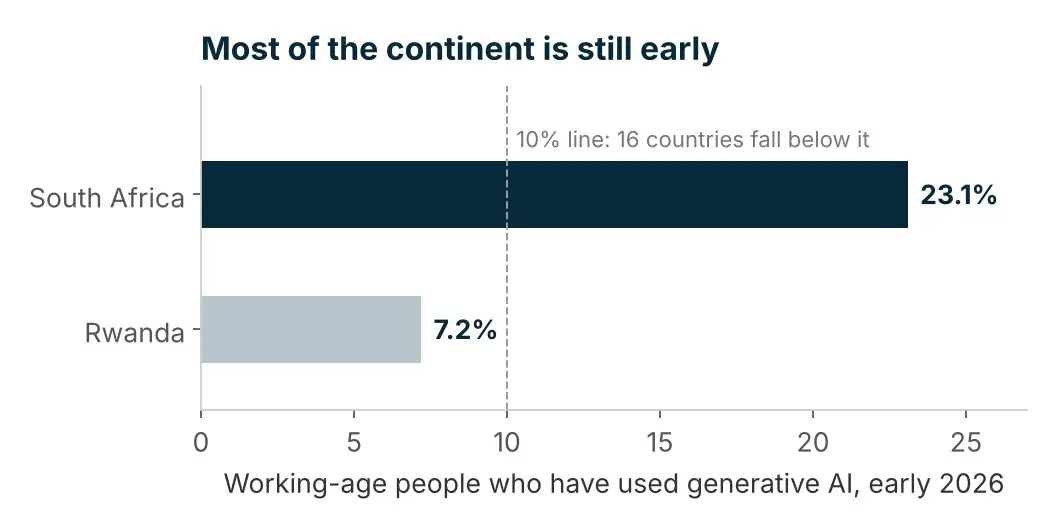
The work of building AI into everyday African life has only just started, and there is room to grow with it. Low adoption today does not mean an easy run. It means the groundwork, the tools, the skills, the infrastructure, is still waiting to be done, and the people who do it early will shape what follows.
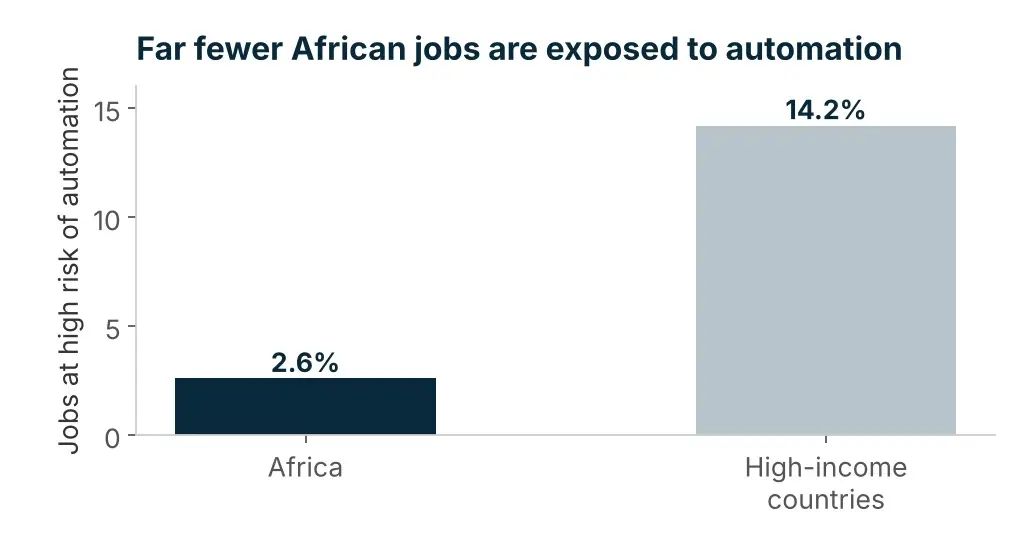
The report also offers a different perspective on AI and employment. In Africa, AI is more likely to help people do their work than to automate their jobs entirely, although the impact will vary across occupations and industries Automation hits fewer jobs on the continent, partly because so much work still sits outside the reach of these tools, through gaps in connection, devices and skills.
Why Small AI Beats Big AI in Africa
You do not need to build the next ChatGPT. Africa’s real chance is in small, practical AI: tools that run on a basic phone, work where connections are patchy and speak the local language. The tools that have taken off here already do this, over text messages, voice calls, and apps people already own. Building well for those constraints is hard in its own right.
Local tools win because the global models barely speak Africa’s languages. They learn mostly from English. The training data behind them holds 88,844 English datasets and just 710 in Swahili, a language spoken by tens of millions. Ask one question in Swahili and it struggles.
A tool built elsewhere often does not understand you. The value is in making AI work for a place, its languages, its people, and its problems. That work is the easiest for people who know the place well, which is your advantage.
Africans are already building it
To make its case, the World Bank reviewed more than 100 AI tools already running across the continent and named the ones delivering real results. Most people have never heard of them, yet they are some of the clearest proof of what works here.
The report singled out Darli AI, built by the Ghanaian company Farmerline. It gives farming advice in more than 27 languages through WhatsApp and voice calls. In its first eight months, it reached 110,000 farmers. It did not win by being flashy. It won by meeting farmers where they already are, in a language they speak every day.
Kenya has one too. A tool called M-Shule teaches children through plain text messages, with no app or smartphone needed. Researchers from Cambridge studied it, found real gains in children's reading, and rated it good value for money. It has reached over 100,000 learners.
In health, Helium Health runs software that keeps working when the internet drops, serving more than a million patients across seven countries, Ghana among them. The same idea runs through all three. Find a real problem. Reach people on something they already own. Design for the conditions on the ground.
So where do you start?
Three things are worth your time.
- Learn to take AI that already exists and make it fit a local need. That is where much of the value is, and it is far more within reach than building your own from scratch.
- Learn to build for how people really use technology across the continent. The basic phone. The text message. The voice call in a local language. Every tool above reaches people that way.
- Pick a field and a language you already know. Darli AI works because its builders understand farmers. Knowing how a clinic or a market really runs, and speaking your users' language, goes a long way toward making a tool good.
The common thread is that your starting point is an advantage. The understanding you already have of the place you come from, paired with the skill to build for it, is what the work calls for.
This is the work we do
That gap is the one AmaliTech was built to close. We train young people in Ghana and Rwanda in the skills this work demands, from software and data engineering to AI app development, and we put that talent to work delivering technology services for clients across Europe and beyond. The World Bank describes the opportunity; our model is one route into it, turning local talent into engineers who can adapt, integrate and build AI that solves real problems for real people.
The tools that serve Africa best will be built by people who understand it. That is your edge. Start building the skills to be part of that work.
Continue Reading
Explore more related stories from our blog, handpicked just for you.
© 2026 amalitech.com | All rights reserved